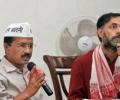
'Arvind's face fell... He started to say something, but couldn't continue. He broke down and as the tears fell unheeded, he crumpled to the floor.'

'What will be achieved by the prime minister's condemnation of each and every unfortunate incident? Will just the PM's condemnation bring about closure to these cases,' asks Sudhir Bisht.

'Much of the Socialism that we attribute to him actually came during Indira Gandhi's time,' says M J Akbar who believes that Nehru's convictions helped shape modern India.

Has New Delhi internalised the truth that it does not matter, asks Saeed Naqvi. Such deafening silence from the government, principal opposition, even the pundits!

'Only the smoke is coming out now. Let us prevent the lava from coming out by taking proper measures.' 'I have told every leader that you cannot have a stable government without winning the confidence of the scheduled castes, scheduled tribes and the most backward castes.' 'Leaders feel that by giving a sop here and there and by symbolic actions, they can win votes. That's all they want. Votes.'

'The "Hollandisation" of British policy may not bring the expected gains as the future may show,' says Claude Arpi.

Let Bihar be damned under its contradictions of having gone 'dry' and then having been submerged under flood, which is a recurrent phenomena? After all it is a godforsaken land, having lost its promises of overcoming its problems, says Mohammad Sajjad.

At these 'relief camps' people had nothing to sleep on except for a piece of cloth and men and women, boys and girls all cramped together. Factor in the fact that Kakching in the 2011 census had a population of 28,746 people and that about 90 per cent of that population has been affected by the floods now, and one can work the math of the crisis at hand.

'By resorting to divisive issues, the BJP is giving the impression that even if it is voted to power it won't do anything new to give Bihar a facelift. It will repel voters with the belief that the BJP can't do anything without communal polarisation as its core ideology. This is sad and unfortunate,' says Mohammad Sajjad.
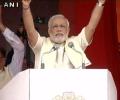
Prime Minister Narendra Modi on Tuesday announced a 'special package' of Rs 1,25,000 crore for poll-bound Bihar during his address at Ara district, in the state.

'The new generation voter is hyper-nationalistic, but it isn't essentially illiberal.' 'They will find the rants of Adityanath as laughable as Irfan Habib's. They will also find the BJP's polarising approach to vote-gathering unacceptable if it fails to deliver jobs and growth,' says Shekhar Gupta.

There are signs of China's external behaviour becoming more aggressive in the coming years. If that happens, strategic implications for neighbours having territorial disputes with China can become deeper and imperatives can rise for the former to counteract, says D S Rajan
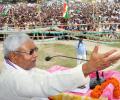
Bihar Chief Minister Nitish Kumar attacks the BJP, saying that its only intention is to capture absolute power.
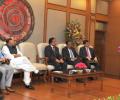
To expect that these past decades of grief, inter-group killings, anxiety and fear will be brushed aside because of the Naga peace accord is being unrealistic. Memories are built on old wounds and they heal slowly. So, it is important to be cautiously optimistic, says Sanjoy Hazarika.

'In the 30 years since the Ayodhya movement began, the RSS has created a generation of Hindus who are the mirror image of those fanatic Muslims who take to the streets at the slightest, even imagined, 'insult to Islam,' argues Jyoti Punwani.

Reason must triumph over blind faith, says Praful Bidwai in this tribute to murdered rationalist Narendra Dabholkar.

'The year in pictures' treks across the globe, looking back on the moments that shaped 2016. From the United States presidential race, to demonetisation in India to the refugee crisis, the news has kept pouring in. Here are our top 50 moments from the world.

'If Modi arrived like a juggernaut, he left like a jigsaw puzzle whose pieces were being dismantled bit by bit. It was as if India had seceded quietly from him.' Shiv Viswanathan's social science fiction about what India would be like in 2020.

'In the first meeting of this new year, we took a joint new year resolution that we will complete it this year. At the time things were not very clear, but the mood was clear that yes, we must resolve it.' 'Yes, details have to come out, but there are some sensitivities, there are some stake-holders not yet on board, especially other Naga undergrounds etc, we would like them to come on board... So at a proper time it has to be revealed to the country, and to the legislature. Perhaps, we may have to wait for some more time.' 'With better understanding of the Indian system, many of them have learnt, realised, appreciated that Naga nationalist aspirations can be accommodated in the Indian system. The Indian system is pretty comprehensive and flexible.' 'A Naga has as much stake, claim over India as any other Indian. There is no distinction. This, Nagas have realised, that yes, Naga nationalist aspirations and Indian nationalism are not mutually exclusive.' Ravindra Narayan Ravi, the Government of India's Special Interlocutor for the Naga talks, explains how the Naga Peace Accord was reached in an exclusive interview to Saisuresh Sivaswamy/Rediff.com
